
Niagara County Weekly Arrest Sources
The Sheriff's Office keeps no weekly booking archive online. Its Recent News page runs as a rolling feed. Some releases describe arrests or investigations. A few include an image. Coverage is selective, though. Treat it as highlights, not as everyone booked at the Niagara County Correctional Facility.
For a true weekly record, turn to the Tribune-Sentinel/Dispatch. Its dated editions carry a Niagara County Sheriff's Office blotter sorted by service zone. The paper calls the material a limited sample of calls and arrest activity. That honesty helps. The blotter is a dated news record, not a jail roster or a court file.
Read Niagara’s Police Blotter
Work from the dated news toward the primary record.
- Check NCSO Recent News for a selected Sheriff announcement and note its publication date.
- Open the Tribune-Sentinel category and locate the edition whose stated reporting period covers the event.
- Identify the agency. A Sheriff zone item and a city police report have different custodians.
- Compare the event, arrest, and publication dates. A later article may describe an earlier arrest.
- Use the NCSO roster only to test present county custody. The Daily Arrest Report explains that same-day route.
- Ask the arresting agency for its report and the court for the disposition.
A paper can summarize a police release. For identity, current status, and case detail, rely on the originating government record.
Niagara Arrest Log Fields
Fields vary because Niagara has no single official multi-day interface.
| Field | Use and limit |
|---|---|
| Name | Verify spelling and identity with the agency. A shared name is not enough. |
| Event or arrest date | May precede the article. Keep it separate from booking and posting dates. |
| Agency or service zone | Points to the likely custodian, though a news item may summarize several responders. |
| Charge | An charge reported at that stage. It may change or be dismissed. |
| Location | Can identify a service area; it does not prove where the person was held. |
| Photo | Not guaranteed. Its absence does not mean no arrest occurred. |
| Outcome | Confirm with the court. A story is not a live status system. |
The official NCSO release stream illustrates its selected-news format.
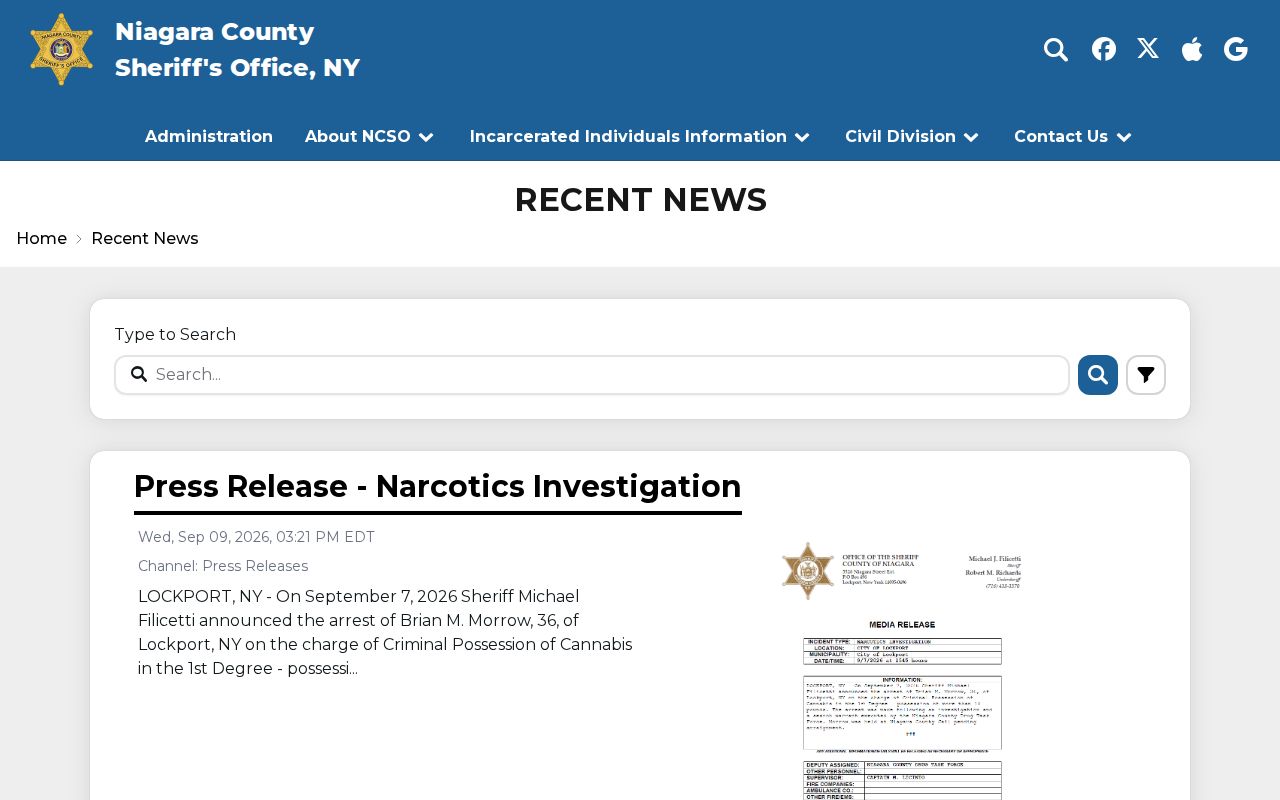
It adds arrest context, not a full booking ledger.
Niagara Weekend Arrest Reporting
NCSO posts no weekend schedule for releases or its roster. The Tribune-Sentinel runs on a weekly rhythm. A Saturday arrest may surface in a later edition while custody has already shifted. Delayed publication is not release. Search the likely date range first, then use the Niagara County recent arrests hub for official custody, records, and court routes.
In an emergency, call 911. A news search is no emergency notification service. For a named person, the Sheriff roster tests current county custody, while the arresting city can account for an appearance ticket or a city-held period.
Older Niagara Arrest Records
The Sheriff roster lists no archive depth. Recent News keeps selected items, and the Tribune-Sentinel offers dated back editions. Lockport Public Library holds Union-Sun & Journal microfilm from October 1899 onward. The film has gaps and no index. A newspaper archive cannot prove that every booking or booking photo survived.
New York Correction Law §500-f requires a permanent daily record of commitments and discharges. Start with a precise FOIL request to NCSO. Give a name, date range, agency, and record type. A record may have been transferred or lawfully destroyed. Ask where it went and under what authority. Court outcomes sit with the clerk.
Why Niagara’s Blotter Is Limited
The Tribune-Sentinel category supplies a dated local-news route.
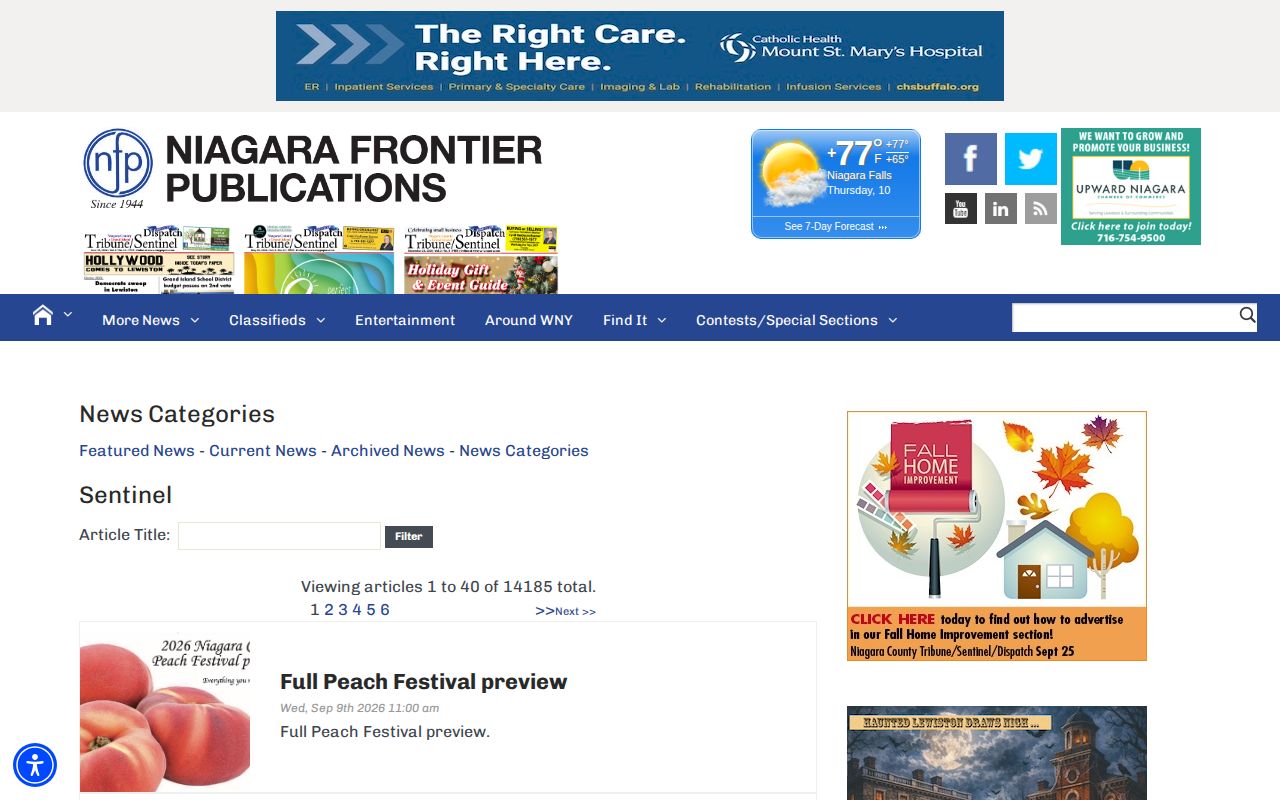
The blotter's archive helps fix a timeline, yet its own limited-sample wording keeps it from serving as a full arrest log. Niagara Express has run a Niagara Falls police-blotter piece. Niagara Gazette covers city and county crime news, though no stable blotter category exists. Lockport Union-Son & Journal is secondary for Lockport court stories. These outlets pick their stories and may reshuffle archives. When you cite one, give the date, the byline, and the named agency.
Primary Niagara Arrest Records
Commercial county indexes trade on names, dates, charges, photos, and longer windows. None is official. All are copied, gappy, and often stale. Recently Booked shows a rolling county view; Busted Newspaper keeps a deeper archive; Mugshots.com offers older year and city filters; Arrests.org sits stale or empty. A blank result proves nothing.
The NCSO press portal landing page marks an access boundary.
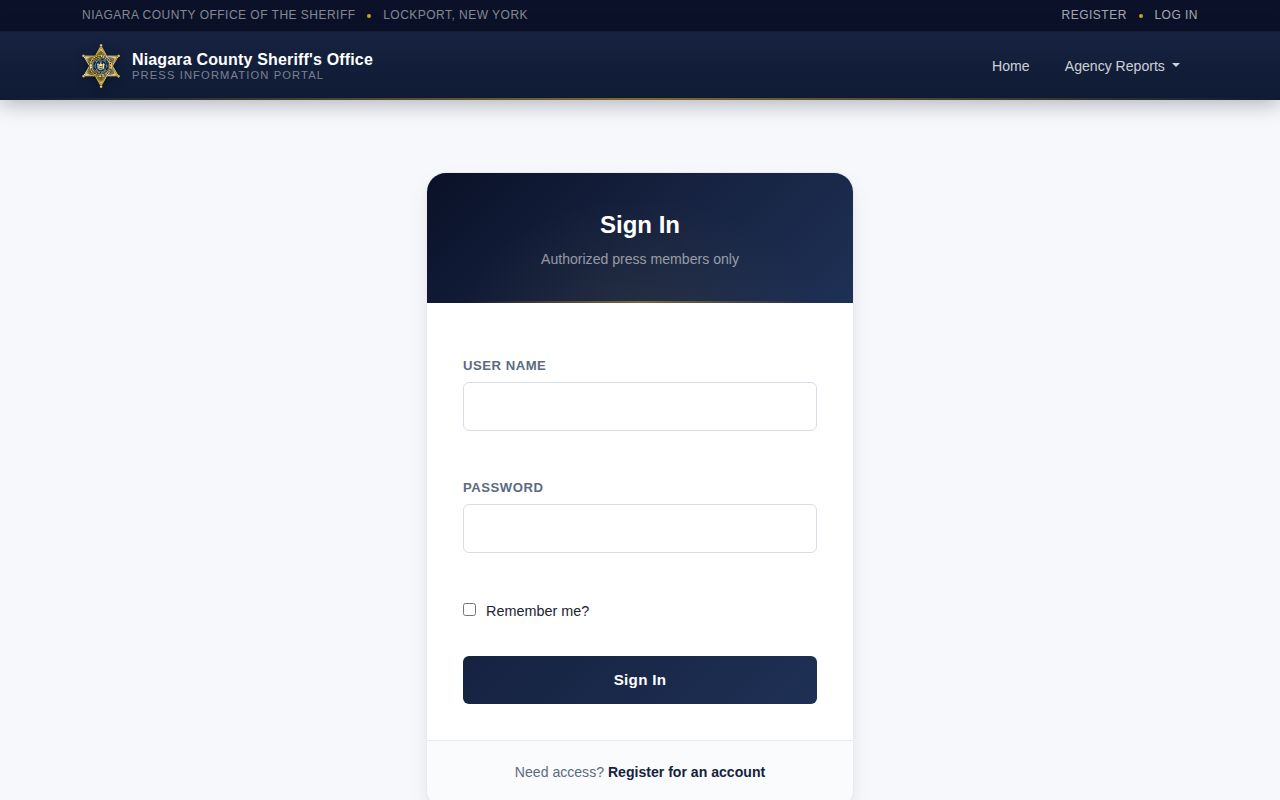
The portal sits behind authorization. It is not an open public blotter. For confirmation, return to NCSO, the arresting agency, the correct court, or a FOIL request.
Which Niagara Agency Holds Records?
A weekly source may name a department, a Sheriff zone, or a court. That name points your request. NCSO holds the jail and Sheriff records. Niagara Falls, North Tonawanda, and Lockport keep their own records. County custody starts only when the correctional facility accepts a person. Before that, a city may hold someone. It may issue an appearance ticket, or route the case elsewhere.
No city posts a searchable current arrest log. Follow a news mention straight to the named police unit. Bring the event date, the location, and a report number if you have one.
Follow Niagara Arrests Into Court
The log captures an early stage only. County Court tries felonies. City, town, and village courts handle lesser matters. Ask the right clerk for a docket or a Certificate of Disposition, the court's recorded outcome, whether a dismissal, plea, trial result, or other resolution.
That is why old news can mislead. A first charge may later change or be dismissed, and sealed matters may no longer be open. Say "arrested," "charged," or "booked" only when the record supports it.
Request a Niagara Arrest Log
Public pages miss some Niagara County arrests. When dates slip through, describe the record you need rather than asking for everything. Write the Sheriff FOIL Office at P.O. Box 496, Lockport, NY 14095. Include the name, a rough date, and the agency. Name the exact item too, such as the permanent daily entry, booking sheet, incident report, discharge record, or lawfully disclosable image. Request electronic delivery up front. The custodian may redact sealed, juvenile, victim, medical, grand-jury, or safety-sensitive material, so keep any written denial and use its appeal process. City arrests belong with that department first. The County Clerk suits a criminal case, and libraries only hold published narratives.
Public Record Search
Sponsored Results
Build a Reliable Niagara Timeline
A careful timeline reconciles sources that seem to clash. Note the event time, the arresting agency, and the county commitment date if you obtained one. Add the publication date of each source. Log every online check too. A news article can lag police activity by days. A roster can change before the weekly paper prints. Court filings often carry a later date than the Niagara County arrest itself, and flattening these gaps into one arrest date hides what actually happened. Save the source link and label it official, local news, or unofficial. With a common name, add only the facts that isolate the right record. Confirm the charge with the agency. Confirm the outcome with the clerk. That gives you a clean chain from event to booking, publication, custody, and disposition, and it keeps a stale booking photo or dropped charge away from the wrong person.
Two sources will disagree sometimes. Trust the agency that made the record first, then the jail custodian, then the court for the outcome. A Niagara County newspaper adds context. Its editing makes it incomplete by design, so save the source date and ask the custodian to explain any mismatch instead of guessing.